
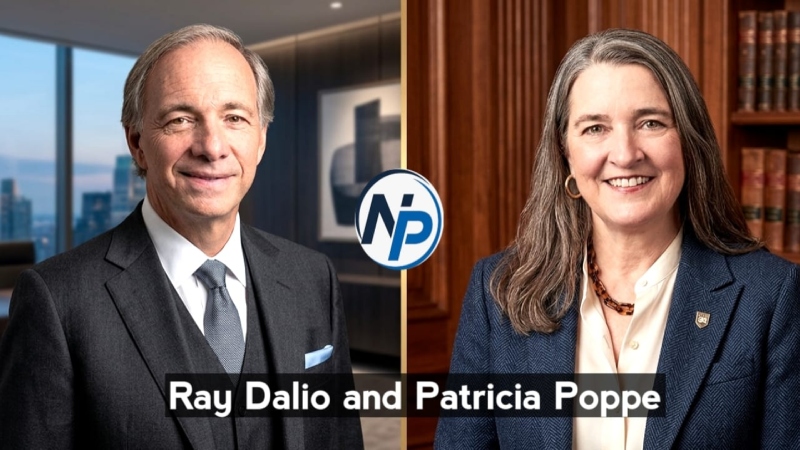
Ray Dalio and Patricia Poppe come from different corners of the business world. Dalio built his career around financial markets, investment research, and economic decision-making. Poppe developed hers through engineering, manufacturing, and the energy industry before becoming the chief executive of PG&E Corporation.
At first, there may not seem to be much connecting their stories. One spent decades studying markets and building an investment firm, while the other moved through factories, power plants, and utility operations. Yet their careers raise a similar question: how do leaders make decisions when the problems in front of them are complicated and the consequences can be significant?
Looking at their professional journeys side by side offers a useful way to understand two very different approaches to leadership.
Ray Dalio’s Journey From Investor to Founder
Ray Dalio’s interest in investing began when he was young. Bridgewater’s official biography says he bought his first stock at age 12 after earning money as a golf caddie. That early experience developed into a long-term interest in financial markets.
Dalio studied finance at C.W. Post College and later earned an MBA from Harvard Business School. After brief periods at Wall Street firms, he founded Bridgewater Associates in 1975 from his two-bedroom apartment in New York.
Bridgewater started on a much smaller scale than the institution it eventually became. In its early years, Dalio worked with institutional investors on financial risks and market exposures. The firm also produced economic research for clients.
One important milestone came in 1985, when Bridgewater began managing a $5 million account for the World Bank. That relationship helped establish the firm’s reputation among institutional investors.
Over the following decades, Dalio became strongly associated with global macro investing. Instead of looking only at individual companies, this approach examines larger forces such as economic growth, inflation, interest rates, currencies, and changes in monetary policy.
Why Ray Dalio Became Known Beyond Investing
Dalio’s influence extends beyond the investment decisions made at Bridgewater.
He also developed a distinctive philosophy about how organizations should make decisions. Bridgewater describes the culture he helped establish as an “idea meritocracy,” where ideas are expected to be examined on their merits rather than accepted simply because of someone’s position in the organization.
This philosophy placed considerable importance on questioning assumptions, discussing mistakes, and making disagreements visible.
Dalio later explained many of these ideas in his book Principles: Life and Work. The book brought his approach to decision-making and management to a much broader audience.
However, his current role should not be confused with his historical position at Bridgewater. Dalio stepped down as CEO in 2017, as CIO in 2020, and as chairman at the end of 2021. Bridgewater says he now focuses mainly on mentoring and sharing the lessons he developed during his career.
Bridgewater’s current CEO is Nir Bar Dea, who has held that position since 2022.
Patricia Poppe’s Early Career
Patricia K. Poppe, widely known as Patti Poppe, took a very different route.
Her background is rooted in engineering and industrial operations. Before entering senior utility leadership, she held several plant management positions at General Motors. She later joined DTE Energy, where she became a power plant director.
Poppe then spent about a decade at CMS Energy and its principal subsidiary, Consumers Energy. During that period, she held leadership roles covering areas such as distribution operations, engineering, transmission, customer operations, rates, and regulation.
She eventually became president and CEO of CMS Energy and Consumers Energy.
This progression is significant because Poppe’s experience was built close to the actual operation of large industrial systems. Her career involved people, equipment, infrastructure, customers, and processes rather than financial markets alone.
Education Behind Poppe’s Career
Poppe’s education also reflects her technical background.
She earned both a bachelor’s degree and a master’s degree in industrial engineering from Purdue University. She later completed a master’s degree in management at Stanford University’s Graduate School of Business.
That combination of engineering and management education fits the direction of her career. She developed technical knowledge first and then moved into increasingly broad leadership responsibilities.
Her professional experience followed a similar pattern, moving from plant-level operations toward executive management.
Patricia Poppe and PG&E
Poppe joined PG&E in January 2021 as chief executive officer of PG&E Corporation. Before that appointment, she had spent five years leading CMS Energy and Consumers Energy.
PG&E operates in an environment where leadership decisions can have a direct effect on infrastructure, customers, employees, regulators, and communities.
The company’s responsibilities include maintaining energy infrastructure, improving reliability, managing safety risks, controlling costs, and preparing for changes in California’s energy demand.
That makes Poppe’s leadership environment fundamentally different from Dalio’s.
An investment manager can adjust a portfolio when economic conditions change. A utility has to maintain physical systems that operate every day and serve customers continuously.
Poppe’s Focus on Operations and Customers
Poppe’s background in lean management has influenced how she approaches organizational improvement.
At PG&E, the company has emphasized process improvements, safety, reliability, affordability, and infrastructure resilience. Its 2025 sustainability report describes efforts to improve the energy system while also controlling operating costs and preparing for increasing electricity demand.
PG&E reported that electricity demand could double by 2040, with growth driven by areas such as data centers, electric vehicles, and electrification of homes and businesses.
That creates a complicated leadership challenge. The company has to prepare for greater demand while also considering affordability and the cost of building and maintaining infrastructure.
In September 2026, PG&E announced a strategic review and said it planned to defer approximately $2 billion of work scheduled for 2027. The company said critical safety investments and compliance obligations would remain in place while it reviewed ways to reduce financing costs and improve affordability.
This provides a current example of the type of trade-offs involved in Poppe’s role.
What Do Ray Dalio and Patricia Poppe Have in Common?
The two executives do not share the same industry or career history.
There is also no reliable evidence establishing that Dalio and Poppe are business partners, relatives, or direct professional collaborators.
What makes the comparison interesting is the nature of the problems they have had to address.
Dalio built systems for understanding uncertainty in financial markets. Poppe has worked with organizations where uncertainty can involve infrastructure, safety, regulation, customer demand, and changing energy requirements.
Both careers therefore involve decision-making under conditions where no single answer solves every problem.
The difference is in the environment.
Dalio’s work has largely involved financial and economic systems.
Poppe’s work has involved industrial and energy systems.
That distinction helps explain why their leadership philosophies developed in different ways.
Two Different Views of Leadership
Dalio’s organizational philosophy emphasizes transparency, questioning, and the examination of ideas. Bridgewater describes its approach as one where people are encouraged to pursue better answers rather than simply accept ideas because they come from senior people.
Poppe’s career reflects a more operational form of leadership. Her experience in manufacturing and utilities places considerable emphasis on how work is performed, how problems are identified, and how large systems can be improved.
Neither approach needs to be treated as a universal formula.
A financial organization and an energy utility face very different responsibilities. What works when evaluating an investment decision cannot simply be transferred to maintaining a power grid.
The more useful lesson is that leadership methods often develop around the problems an organization actually faces.
Ray Dalio vs. Patricia Poppe
| Area | Ray Dalio | Patricia Poppe |
|---|---|---|
| Primary field | Investment management | Energy and utilities |
| Best-known organization | Bridgewater Associates | PG&E Corporation |
| Background | Finance and investment | Engineering, manufacturing, and energy |
| Major focus | Markets, economics, and investment decisions | Operations, infrastructure, safety, and customers |
| Leadership perspective | Ideas, transparency, and decision-making | Operations, improvement, and customer service |
| Current position | Founder and mentor at Bridgewater | CEO of PG&E Corporation |
This comparison is descriptive rather than a judgment about which approach is better. Their responsibilities are simply different.
Why Their Stories Are Relevant Today
The careers of Dalio and Poppe also illustrate how leadership changes as organizations grow.
Dalio started Bridgewater from a small apartment and eventually built a major investment institution. His later transition away from executive control shows another aspect of leadership: building an organization that can continue beyond its founder. Bridgewater says its transition to the next generation of leadership was completed in 2022.
Poppe’s story shows a different kind of progression. She moved from technical and plant-level positions into senior executive roles and eventually took responsibility for one of the largest utility organizations in California. PG&E continues to list her as its CEO.
Their careers therefore demonstrate two different forms of professional development: building an institution from the ground up and advancing through increasingly complex operational responsibilities.
Frequently Asked Questions
Are Ray Dalio and Patricia Poppe business partners?
There is no reliable evidence showing that Ray Dalio and Patricia Poppe are direct business partners. They are leaders associated with different organizations and industries.
Is Patricia Poppe also called Patti Poppe?
Yes. Patricia K. Poppe is commonly referred to as Patti Poppe, including in PG&E’s official corporate materials.
What is Ray Dalio known for?
Ray Dalio is best known for founding Bridgewater Associates and for his work in investment management, economic analysis, and organizational principles.
What is Patricia Poppe known for?
Patricia Poppe is known for her leadership career in manufacturing and energy and for serving as CEO of PG&E Corporation. Before joining PG&E, she led CMS Energy and Consumers Energy.
Where did Patricia Poppe study?
Poppe earned bachelor’s and master’s degrees in industrial engineering from Purdue University and a master’s degree in management from Stanford University’s Graduate School of Business.
Does Ray Dalio still run Bridgewater?
No. Dalio stepped away from Bridgewater’s CEO, CIO, and chairman positions over several years. The firm is now led by CEO Nir Bar Dea.
Conclusion
Ray Dalio and Patricia Poppe followed very different routes to leadership.
Dalio built his career through finance, investment research, and the creation of Bridgewater Associates. His work became associated with global macro investing and a management philosophy centered on examining ideas and learning from mistakes.
Poppe developed her career through engineering, manufacturing, and the energy sector before becoming CEO of PG&E Corporation. Her work is closely tied to the practical challenges of running a large utility, including safety, infrastructure, reliability, affordability, and changing energy demand.
There is no need to invent a personal connection between the two. Their separate careers already provide an interesting comparison. One shows how an investment institution can be built around research and decision-making; the other shows how technical and operational experience can lead to leadership of a major energy company.
Together, their stories provide two distinct perspectives on what it means to lead an organization through uncertainty and change.