
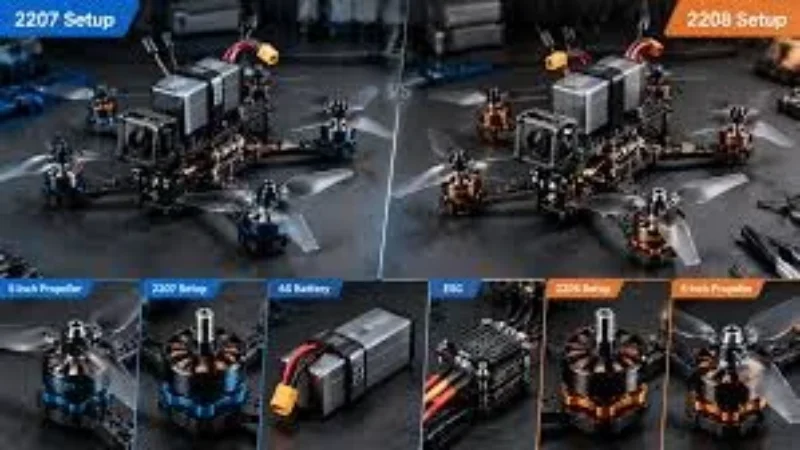
Stator size is the most consequential decision in a motor and the one pilots shop most casually. A 2207, a 2306, and a 2208 all bolt to the same frame, all accept 5-inch props, and all cost roughly the same—and they fly noticeably differently. Choosing wrong doesn’t stop the quad from flying; it just makes it feel wrong in a way no PID tune can fix.
The reason comes down to geometry. This is the short version of how to read it and why the 2207 remains the safest default for a general-purpose 5-inch—the kind of thing you notice the moment you swap a set of 2207 motor onto a frame you already know.
The math you should do once
Volume ≈ π × (d/2)² × h, so it scales with diameter squared and height linearly:
| Size | Volume | Volume vs 2207 | Character |
| 2207 | 3,388 mm³ | baseline | Balanced; torque depth + RPM tolerance |
| 2306 | 3,312 mm³ | −2% | Wider, shorter. Faster acceleration, slightly less deep torque |
| 2208 | 3,872 mm³ | +14% | More torque and more mass; more amps |
| 2306.5 | 3,590 mm³ | +6% | Long-range compromise |
Nearly identical volume, three different behaviors—because diameter buys torque at the prop, height buys RPM headroom. A wider stator accelerates a prop faster off the line. A taller one holds torque deeper into the throttle range and handles prop loading at high RPM with less struggle.
2207: the all-rounder, and why it stayed
The 2207 is the default for three concrete reasons:
- It’s the middle of the torque/RPM trade. It doesn’t do anything best, which is exactly why it does everything well enough for freestyle, racing, and cinematic flying.
- Prop tolerance. It’ll run a 5145 tri-blade, a 5146, or a 5.1″ bi-blade without complaint. Wider stators get fussier about loading.
- Ecosystem. Every tune, every build guide, and every thrust-test database has 2207 data. That’s worth more than 3% of anything.
Modern 2207s have also closed the gap that used to favor 2306. Better windings and lower internal resistance mean faster throttle response without changing the geometry—a modern 2207 at ~56mΩ responds like a 2306 from three years ago, while keeping the taller stator’s torque behavior.
2306: the freestyle specialist
Buy a 2306 if your flying is all-direction changes: tight gaps, tumbling tricks, and technical lines. The lighter rotating mass and wider stator make it snap faster, and in freestyle, snap is feel.
Don’t buy a 2306 expecting more top-end or better efficiency—it isn’t either. And on a 7-inch or a heavy camera rig, the shallower stator runs out of torque authority before a 2207 or 2208 does.
2208: the heavy-lift choice
A 2208 is a 2207 with 14% more stator volume, and that extra volume shows up as torque—the ability to spin a heavier prop or a heavier quad without bogging. It’s the right choice for:
- 5-inch builds carrying a full GoPro + big battery (heavier AUW)
- 5.5-inch props
- Pilots who fly at altitude or in heat, where torque margin matters
The cost: more mass on the bell, more current at the same throttle, and a slightly lazier feel on a light quad. Putting a 2208 on a 350g build is like putting truck tires on a kart.
KV comes after the stator, always.
Pick the stator for the feel, then pick the KV for the voltage:
| Voltage | 5-inch freestyle KV | Notes |
| 6S | 1750–2050 | 1950 is the sweet spot; 2050 is for aggressive |
| 6S (heavy/cinematic) | 1700–1800 | Efficiency over punch |
| 4S | 2400–2750 | Higher KV recovers RPM; more current |
| 8S (rare on 5″) | 1200–1500 | Only on high-voltage stacks with the right ESC |
The rule that keeps motors alive: higher KV on the same prop and voltage means more current and more heat. 2550KV on 6S with a 5-inch tri-blade is not “more power”, it’s a scheduled failure.
The test that settles it for your build
Take your AUW and your prop, then ask what you need at 50% throttle:
- Light 5-inch (≤650 g AUW), freestyle: 2207 @ 1950 kV. Best all-round.
- Light 5-inch, technical acro: 2306 @ 1950 KV. Snappier.
- Heavy 5-inch (700g+) camera on board: 2208 or 2207 at 1750–1950 kV.
- Cinematic, long flight time: 2207 or 2306 @ 1750KV on 6S.
- Racing: 2207 @ 2050 KV (6S)—the extra torque depth holds speed through corners.
- 4S anything: add ~500 kV to the 6S recommendation and accept the extra current.
What to check on any listing, regardless of size
Thrust at 50% and 100% with a named prop, peak current, internal resistance in mΩ, weight, KV options paired with cell count, and shaft/mounting spec. A listing that gives you all six is a listing from a vendor who tests. One that gives you “up to 1,800g of thrust” is a listing from a vendor who markets.
The 2207 stayed the default for a decade because it’s the least wrong answer for the most builds. Start there; deviate only when you can name the specific thing you’re trading away.